How to Manage Employee Uniforms Without the Spreadsheet Chaos

How to Manage Employee Uniforms Without the Spreadsheet Chaos

To manage employee uniforms, give every role a written kit, record who holds what, set clear rules for replacements and returns, and review spending each quarter. Small teams can do this in a spreadsheet. Once you have several locations or regular turnover, an ordering portal or managed uniform program does it with less admin.

What does it mean to manage employee uniforms?

Managing employee uniforms means running five jobs on a repeating cycle: issuing garments, tracking who has them, replacing worn items, collecting them when people leave, and watching the cost. Most companies only notice the work when something breaks. A new hire starts without a shirt, an invoice shows items nobody can find, or two managers order the same polo in different colors.

The good news is that the five jobs are not complicated. They are repetitive, and repetition is what makes a spreadsheet and a good intention fall apart at around the third location. If you are still deciding what a uniform program should include, our 7-step playbook for building an employee uniform program covers the setup. This guide picks up after launch, when the daily running of it lands on someone’s desk.

How do you set a uniform policy that people actually follow?

A uniform policy that works fits on one page and answers four questions: who pays, what each role receives, how replacements work, and what happens when someone leaves. Anything longer gets ignored. Anything vaguer gets argued about at the worst moment, usually when a manager is trying to turn away a request for a fifth shirt.

Who pays for work uniforms?

The employer usually should. The U.S. Department of Labor’s Fact Sheet #16 states that where a uniform is required by an employer, by law or by the nature of the business, “the cost and maintenance of the uniform is considered to be a business expense of the employer.” The same fact sheet says no deduction may reduce an employee’s earnings below the required minimum wage or overtime pay. The fact sheet dates from July 2009 and uses the $7.25 federal minimum, and Arizona’s minimum wage is well above that figure, so there is little room to deduct anything. Check current federal and Arizona rules with your payroll provider or counsel before you set up any payroll deduction.

There is a retention angle too. Asking people to buy required clothing out of their own pay is a quick way to lose good hires in a tight labor market.

How many uniforms should each employee get?

Give each person enough to get through a work week without doing laundry mid-shift. For full-time field and service staff that is often five shirts and two to three pairs of pants, with part-timers on a smaller kit. Put the number in the policy, log it at issue, and add a replacement allowance so people have a reason to look after what they have.

A fixed kit also makes your first-year cost per hire predictable, which finance will appreciate.

How do you track who has which uniforms?

Record the employee, the role, the items and sizes issued, the date, and the condition at return. That is the whole record. Whatever tool you use, those fields are what let you answer “who has the extra large jackets?” without walking to the storage room.

Some guides suggest barcode or RFID tagging, which tracks every garment individually. That is useful for rental fleets that circulate thousands of pieces, but it is more than most owned-uniform programs need. For a company that buys garments outright, tracking by employee and item is enough.

Three habits matter more than the tool:

  • One person owns the record. Shared spreadsheets with five editors drift within a month.
  • Every issue and return gets logged the same day, not “when things calm down”.
  • Once a year, someone compares the record with what is actually in the building.

Spreadsheet, ordering system or managed program: which one fits?

Match the tool to your headcount, your turnover and how many people place orders. The table below uses rules of thumb rather than hard limits, because a 15-person company with constant turnover can outgrow a spreadsheet before a stable 40-person company does.

Approach Fits best when What you still handle Where it breaks down
Spreadsheet and email One site, a small team, low turnover Everything: orders, sizes, stock, returns Duplicate entries, stale sizes, no view of spend by person or location
Uniform ordering system Several roles or sites, HR wants approvals and allowances Catalog rules, stock counts, returns The software orders, but someone still receives, sorts and tracks inventory
Managed uniform program Many locations, steady hiring, no spare admin hours Policy decisions and approvals You rely on your provider, so service quality matters more than price

You will hear the middle option called a company store, an employee uniform portal or a uniform management system. They are the same idea: a private online catalog where employees order approved items within the limits you set. If you are weighing that option, our post on uniform ordering system cost breaks down what each layer typically costs.

How do you handle new hires, size changes and departures?

Build each one as a short routine and you stop improvising. Most uniform trouble happens at these three moments.

New hires

Order the kit before day one. Collect sizes with the offer paperwork, not on the first morning. A new employee who starts in borrowed or mismatched clothes gets a poor first impression of the company, and the manager who covers for it loses an hour. A fragmented ordering process is where this usually goes wrong, and we described the knock-on costs in the cost of fragmented uniform ordering.

Size changes and exchanges

Allow one free size exchange within a set window, say 30 days, and log it. Without a rule, exchanges either never happen, which leaves people in ill-fitting clothes, or happen constantly, which burns stock.

Departures

Decide in advance whether leavers return garments or keep them, and write it down. Returning used clothing is awkward and rarely worth the chase. Many employers let people keep standard garments and ask for return of anything that is costly, such as jackets, outerwear or items carrying a security or access function. Whatever you pick, apply it to everyone. Disputes over missing items are the same problem that fills rental invoices with unexplained charges, which we cover in uniform rental invoice conflicts and missing garments.

When should you replace uniforms?

Replace on condition, not on the calendar. A fixed schedule overpays for people who are gentle on their clothes and underserves the ones who work outdoors. Set simple triggers instead: visible fading, holes, stains that will not clear, a failed zipper, or a logo that has cracked or peeled.

In Arizona the sun does a lot of that work. Outdoor crews see colors fade and fabric thin faster than indoor staff, so heavy-use roles should get their condition checked more often. Pairing a quick quarterly look with a replacement allowance keeps the standard consistent without a large order every spring. Our seasonal workwear guide for Arizona covers fabric choices that hold up in the heat, and good care extends the life of any garment. Our uniform maintenance tips are worth sharing with staff who take uniforms home.

What should you budget and measure?

Track cost per employee per year. It is the one number that tells you whether the program is under control. Add up everything bought in the year, including the initial kits for new hires, then divide by average headcount.

For illustration, suppose a company with 40 employees buys 100 garments in a year at an average of $25 each. That is $2,500 in garments, or $62.50 per employee. Replace those example figures with your own invoices. If the number climbs quarter after quarter, the cause is usually turnover, orders outside policy or an unclear replacement rule, and the record you have been keeping will show which.

Four other numbers are worth a line in your quarterly review:

  • Items replaced per 100 employees, by role
  • Orders placed outside the standard kit
  • Days from a new hire’s start date to a complete kit
  • Hours your team spends on uniform admin each month

The last one gets skipped most often, and it is usually the largest hidden cost.

What mistakes make uniform management fall apart?

Four mistakes show up again and again. They are all fixable in an afternoon.

  1. No single owner. HR, operations and a branch manager each assume one of the others has it.
  2. Sizes recorded once and never updated. People change size, and a stale size means a returned order.
  3. Several suppliers, several styles. Over a year, the same “navy polo” arrives in three different shades.
  4. Reordering only when stock hits zero. A reorder point per item, set a few weeks ahead of the lead time, stops emergency orders.

When does it make sense to hand uniform management to a provider?

Hand it off when uniform admin takes more of someone’s week than the uniforms are worth, or when you add locations faster than you can standardize them. A managed uniform program puts the catalog, the ordering portal, the inventory and the fulfillment under one provider, so your team keeps the policy decisions and drops the logistics.

At Arizona Uniform, the model is ownership rather than rental: no rentals and no laundering, just garments your company owns. Employees order approved items through a branded online portal, and we handle inventory and fulfillment. Our employee uniform program services page explains how a program is set up and what it includes.

Frequently Asked Questions

How often should you replace employee uniforms?

Replace when a garment stops looking professional or stops doing its job, not on a fixed date. Fading, holes, torn seams and cracked logos are the usual triggers. Outdoor roles in Arizona typically reach that point sooner than office or indoor roles, so inspect them more often.

Can you deduct uniform costs from an employee’s paycheck?

Only within limits. Under the federal rule cited above, a deduction cannot push an employee’s pay below minimum wage or cut into overtime, and Arizona has its own wage rules. Ask your payroll provider or an employment attorney before you start any deduction, and get any required written authorization from the employee first.

Should employees wash their uniforms at home?

That depends on your program. Employer-owned garments that employees take home need clear care instructions, which is why we publish our uniform care tips. Rental programs launder the garments for you but charge for that service and for missing pieces. With an owned program like ours, care stays with the employee, and you avoid the invoice disputes that rental brings.

What is the difference between uniform rental and a managed uniform program?

With rental, the provider owns the garments, collects and launders them on a schedule, and bills you per item, including for anything lost. In a managed program, you own the garments and the provider handles design, ordering, inventory and fulfillment. Rental suits companies that want laundering handled. A managed program suits companies that want predictable costs and fewer billing disputes.

How much does it cost to manage employee uniforms?

The garments are the largest cost, followed by the staff time spent ordering, tracking and fixing mistakes. Software adds a setup fee and a platform fee if you buy it yourself, while a provider-run ordering portal is often built into the program. Calculate cost per employee per year using your own invoices, and count the admin hours.

Employees working on the Uniform Ordering System Cost

Uniform Ordering System Cost

A uniform ordering system can cost anywhere from nothing extra to several thousand dollars a year. Buying uniform software yourself usually means a setup fee of roughly $1,000 to $3,000 plus monthly or per-user charges. A company store provided by your uniform supplier is often built into the program, so the real cost sits in the apparel and in the admin hours you save or keep losing.

We get this question from HR and operations managers who have outgrown spreadsheets and email threads. They have seen software demos with polished dashboards and wonder what the monthly bill looks like. The honest answer is that the price tag depends less on the software and more on who owns it, who runs it, and what else is bundled in. This guide breaks down each cost line so you can compare quotes on equal terms.

What is a uniform ordering system?

A uniform ordering system is a private online store where employees order their approved uniforms within rules the company sets. Those rules usually cover which items each role can order, how much each person can spend, and who has to approve an order before it ships.

You will hear it called a company store, an employee uniform portal, or a uniform web store. The names differ, but the core functions are the same:

  • A catalog limited to your approved, logoed items
  • Employee logins, often grouped by location, department, or job title
  • Allowances or budgets that the system tracks automatically
  • Approval workflows for managers or HR
  • Payment options such as company invoicing, credit card, or payroll deduction
  • Reporting on spend by person, location, and item

If your current process is an order form, an inbox, and someone in HR retyping sizes into a supplier email, you already have an ordering system. It just runs on people instead of software. We covered what that version costs in detail in our post on the cost of fragmented uniform ordering.

How much does a uniform ordering system cost?

Expect three cost layers: a one-time setup, an ongoing platform fee, and the labor to run it. Which layers you actually pay depends on the route you choose. The table below compares the three routes employers typically take.


Route Upfront cost Ongoing cost Who runs it Best fit
Buy uniform management software yourself Setup and configuration, commonly quoted around $1,000 to $3,000 Monthly subscription, per-user, or per-store fees, plus integration work Your team manages catalog, users, and vendor orders Large organizations sourcing from several apparel vendors
Build a store on a generic ecommerce platform Design, setup, and apps for approvals or allowances Platform subscription, app fees, transaction fees Your team, plus whoever handles decoration and shipping Companies selling branded merchandise more than issuing uniforms
Company store provided by your uniform supplier Often limited to artwork setup such as logo digitizing Usually folded into apparel pricing The supplier manages the store, decoration, and fulfillment Companies that want uniforms handled end to end

The first two routes give you a tool. The third gives you a tool plus the people behind it. That difference matters more than the monthly fee, because the software is rarely the expensive part.

What drives the price of uniform software?

Platforms sold directly to employers or to uniform distributors usually price in one of four ways:

  • Per store or portal: a flat fee for each branded store, which suits a single company with one catalog
  • Per user: a charge for each active employee login, which gets expensive with high turnover
  • Tiered plans: bundles that add features such as approvals or reporting at higher price points
  • Transaction fees: a percentage of each order, which scales with how much you buy

Integration is the line item people miss. Connecting a portal to payroll for deductions, to an HR system for new-hire rosters, or to accounting for invoicing can mean custom work quoted separately from the subscription.

What hidden costs come with a uniform ordering system?

The biggest hidden cost is labor, and it exists with or without software. Someone still has to maintain the catalog, onboard new hires, fix wrong sizes, chase approvals, and reconcile invoices. The question is whether that someone is on your payroll or your supplier’s.

Here are the costs that rarely show up on a software quote:

  • Logo digitizing and artwork setup. Every embroidered logo needs a digitized file before production. This is usually a one-time charge per design.
  • Minimums and inventory commitments. Some programs require you to prepay for stock that sits in a warehouse. Ask who owns unsold inventory if you change a logo or a supplier.
  • Returns and exchanges. Wrong sizes are the most common reason uniform orders get reshipped. Size charts, fit samples, and sizing sessions at rollout cut this cost more than any software feature.
  • Kitting and shipping. Sending individually packed, labeled bundles to each employee or location costs more than one bulk box to headquarters, and saves your team hours of sorting.
  • Payroll deduction setup. If employees pay for extra items, someone has to configure and reconcile deductions.
  • Switching costs. Rental contracts in particular can carry buyout charges for garments in circulation. Read the exit terms before you sign anything new.

How much does manual uniform ordering cost in staff time?

More than most managers expect. According to the U.S. Bureau of Labor Statistics, private industry employer compensation costs averaged $46.89 per hour worked in June 2026, counting wages and benefits together. That figure turns vague complaints about “uniform headaches” into a budget line.

Take a 150-person company with three locations. If an HR coordinator spends four hours a week collecting sizes, placing orders, answering “where is my shirt” emails, and fixing mistakes, that is 208 hours a year. At $46.89 an hour, the manual process costs about $9,750 annually before a single garment is bought. Add turnover, where every new hire restarts the cycle, and the number climbs. This is an illustrative estimate, so plug in your own hours.

Run that math before comparing software quotes. A $300 monthly subscription looks expensive next to “free” email ordering, until you price the email ordering honestly.

Is buying uniform software cheaper than a supplier company store?

For most companies with one primary uniform supplier, no. Buying software makes sense when you manage many apparel vendors and have staff to run the platform. When one supplier handles your uniforms, paying separately for a portal duplicates something that supplier can provide.

Owned software can still be the right call. Large organizations with procurement teams, several vendors, and strict IT requirements often want the platform under their control. Everyone else is usually better served by asking a different question: which supplier gives me a well-run store as part of the program?

That is the model we use. At Arizona Uniform, private company stores are part of our employee uniform programs. Employees log in, see only the items approved for their role, and order within the budget you set. Orders can route through approvals, and you can pay by company invoice or set up payroll deduction for extra items. We handle decoration and ship orders individually packed and labeled, anywhere in the country, from our Tucson facility.

How do allowances and payroll deduction affect the cost?

Allowances cap your spend, and payroll deduction shifts extra purchases to the employee. Both work best when the ordering system enforces them automatically, because manual tracking is where budgets leak.

A common setup gives each employee a yearly allowance split into seasonal windows, for example a spring order for lightweight shirts and a fall order for outerwear. When someone wants more than the allowance covers, the store charges the difference to a card or through payroll deduction. The company pays only for what policy says it pays for.

Compare that with a cash uniform allowance, where you hand out money and hope it turns into logoed shirts. We compared the two approaches in uniform program vs. uniform allowance.

What should you ask before signing up for a uniform ordering system?

Ask for the total cost of ownership in writing, not just the monthly fee. These questions surface the costs that sales conversations tend to skip:

  1. Is there a setup fee, and what exactly does it cover?
  2. Do fees change as we add employees, locations, or catalogs?
  3. Are logo digitizing and sample garments charged separately?
  4. Who maintains the catalog and the employee list, and who handles new hires?
  5. How are wrong sizes and exchanges handled, and who pays return shipping?
  6. Can the store enforce allowances, approvals, and payroll deduction without custom work?
  7. Are there minimum order quantities or inventory we must prepay?
  8. What reports do we get, and how often?
  9. What happens to our data, artwork, and remaining stock if we leave?
  10. Is there a contract term or cancellation fee?

Our uniform program provider checklist goes deeper on evaluating suppliers, including service levels and turnaround times.

When is a uniform ordering system not worth the cost?

When your team is small, works from one location, and orders once or twice a year, a portal may be overkill. A clear order form and a supplier who confirms sizes by phone can be enough.

The tipping point usually arrives with growth. Multiple locations, frequent hiring, different uniforms by role, or managers who need spending visibility all push the manual process past its limit. If you recognize those signs, our post on the operational advantages of a digital uniform ordering system explains what changes day to day once ordering moves online.

Does renting uniforms include an ordering system?

Rental services often include some form of online account, but you pay for it inside a long-term contract. Weekly rental charges, replacement fees for lost or damaged garments, and buyout terms at the end of the agreement can make the true cost hard to see.

Direct purchase works differently. You own the uniforms, there is no weekly service charge, and the store exists to make reordering simple rather than to lock in a term. If you are already renting and struggling to match invoices to what employees actually have, read our breakdown of uniform rental reconciliation problems.

How can you estimate your own uniform ordering system cost?

Add four numbers: setup, annual platform fees, annual admin hours times loaded labor cost, and annual waste from returns and unused stock. Then compare that total across each option you are considering.

  • Setup: software configuration, store design, and logo digitizing
  • Platform fees: subscription, per-user, or transaction charges for a full year
  • Admin time: weekly hours spent on uniforms, times 52, times your loaded hourly cost
  • Waste: reshipping wrong sizes, write-offs of unused stock, and rush charges

Most employers who run this exercise find the platform fee is the smallest of the four. The biggest savings come from cutting admin time and sizing errors, which is where a supplier who runs the program for you pays for itself. For a step-by-step rollout plan, see our guide to building a uniform program, and for what full management includes, see managed uniform program services.

Frequently Asked Questions

Is a company uniform store free?

Some uniform suppliers include a company store as part of a direct-purchase program and charge only for artwork setup and the apparel itself. Standalone software almost always carries setup and recurring fees. Ask each provider to list every charge in writing.

What is the difference between a company store and uniform management software?

Uniform management software is a tool you license and run yourself. A company store from your supplier is the same kind of ordering experience, but the supplier maintains it and connects it directly to decoration and fulfillment.

How long does it take to set up a uniform ordering system?

Timelines vary with catalog size, number of locations, and how rules are configured. The slowest steps are usually approving items, finalizing logos, and collecting employee sizes, not building the store itself.

Can employees pay for extra uniforms through a company store?

Yes. Most stores let employees pay by card for items beyond their allowance, and many support payroll deduction when the employer sets it up.

Does a uniform ordering system work for multiple locations?

Yes, and that is where it earns its keep. Stores can group employees by location, show different catalogs or budgets for each, and ship orders directly to each site or employee.

How do I get a quote for a uniform program with a company store?

Tell us your headcount, locations, and the items you need, and we will outline how a program would work for your team. You can reach us through our contact page or review common questions on our FAQ page.

dry fabric cloth

Quick-Dry Fabrics for Car Wash Employees: Technology and Benefits

Car wash employees face constant exposure to water, creating unique challenges that standard uniforms cannot address. Soaked clothing leads to discomfort, reduced productivity, potential health issues, and rapid uniform deterioration. Quick-dry fabric technology has transformed workwear for wet environments, offering car wash operators a practical solution that benefits both employees and business operations. Understanding how these fabrics work and their advantages helps car wash managers make informed decisions about uniforms that improve workplace conditions while reducing costs.

The Science Behind Quick-Dry Fabric Technology

Quick-dry fabrics operate through sophisticated engineering that manages moisture differently than traditional materials like cotton. These performance textiles combine specialized fiber construction with moisture-management chemistry to actively transport water away from the skin while accelerating evaporation.

The process begins with capillary action, in which microscopic channels within synthetic fibers draw moisture from the fabric’s inner surface to its outer surface. This wicking effect spreads moisture across a larger surface area rather than allowing it to saturate one area. Polyester and nylon fibers, the foundation of most quick-dry fabrics, feature hydrophobic properties that resist water absorption, while their cross-sectional shapes (often X-shaped or triangular) create additional pathways for moisture to move.

Advanced quick-dry fabrics frequently incorporate a dual-face construction, with hydrophilic treatments on the inner surface that draw moisture away from the skin and hydrophobic treatments on the outer surface that facilitate rapid evaporation. This push-pull mechanism ensures moisture continuously moves in one direction—away from the wearer’s body.

Moisture-Wicking vs. Quick-Dry: Understanding the Difference

While often used interchangeably, moisture-wicking and quick-dry describe related but distinct fabric properties that work synergistically in quality car wash uniforms. Moisture-wicking refers specifically to a fabric’s ability to pull sweat and water away from skin through capillary action. Quick-dry describes how rapidly a fabric releases moisture into the air through evaporation.

The best uniforms for car wash environments combine both technologies: wicking moisture away from employees’ skin while drying fast enough to maintain comfort throughout long shifts. This combination prevents the clammy, heavy feeling that occurs when fabrics wick moisture but dry slowly, leaving employees in damp clothing for extended periods.

Fabric Compositions That Deliver Performance

Several synthetic fiber types excel in car wash applications, each offering specific advantages based on operational needs and climate conditions.

Polyester remains the most common quick-dry fiber, prized for its durability, cost-effectiveness, and excellent moisture management. Modern polyester blends dry up to 50 percent faster than cotton while maintaining shape and color through repeated laundering and chemical exposure. For car wash operations, polyester’s resistance to chemical degradation makes it particularly valuable when employees handle cleaning solutions regularly.

Nylon offers similar quick-dry properties, a slightly softer hand feel, and exceptional abrasion resistance. This makes nylon-based uniforms ideal for employees who frequently kneel, lean against vehicles, or handle equipment that might abrade standard fabrics. Nylon dries marginally faster than polyester while offering superior tear resistance.

Polyester-cotton blends balance performance with comfort for operations seeking middle-ground solutions. These blends typically feature 60 to 70 percent polyester for moisture management combined with cotton for breathability and a familiar feel. While not as fast-drying as 100 percent synthetic options, quality blends significantly outperform pure cotton while offering enhanced comfort for employees unaccustomed to fully synthetic workwear.

Tangible Benefits for Car Wash Operations

Implementing quick-dry uniform programs delivers measurable improvements across multiple operational areas, from employee satisfaction to bottom-line costs.

Employee Comfort and productivity improve dramatically when workers remain dry throughout their shifts. Wet clothing causes physical discomfort that becomes a constant distraction, reducing focus and work quality. Employees in quick-dry uniforms maintain better morale and demonstrate higher productivity, particularly during busy periods when breaks are limited. This comfort factor also reduces turnover in an industry where employee retention remains an ongoing challenge.

Health and Safety Considerations extend beyond immediate comfort. Prolonged exposure to damp clothing increases the risk of skin irritation, fungal infections, and, in colder months, dangerous drops in core body temperature. Quick-dry fabrics minimize these health risks by keeping skin drier throughout the workday. Additionally, lighter, less saturated uniforms reduce physical strain on employees who otherwise work while carrying extra weight from water-soaked clothing.

Extended Uniform Lifespan represents significant cost savings over time. Traditional cotton uniforms subjected to constant wetting deteriorate rapidly. Fibers weaken, seams fail, colors fade, and fabric develops musty odors that persist despite washing. Quick-dry synthetic fabrics withstand these conditions far better, maintaining structural integrity and appearance through hundreds of wash cycles. While initial per-garment costs may exceed those of cotton alternatives, the total cost of ownership typically favors quick-dry options due to extended replacement cycles.

Professional Appearance Throughout Shifts matters significantly in customer-facing car wash operations. Employees in saturated, clinging cotton shirts project an unprofessional image that undermines customer confidence. Quick-dry uniforms maintain their shape and appearance even when wet, drying rapidly during brief breaks to restore crisp presentation. This consistent professional appearance supports brand image initiatives and customer perception of service quality.

Climate Considerations for Arizona Operations

Arizona’s unique climate creates specific requirements for car wash uniforms that operators in more temperate regions may not consider. The combination of extreme heat, intense UV exposure, and low humidity affects both how quickly fabrics dry and how comfortable they remain during use.

Quick-dry fabrics excel in Arizona’s low-humidity environment, where evaporation rates naturally accelerate. However, the same intense heat that speeds drying can make poorly ventilated synthetics uncomfortable. Quality quick-dry uniforms designed for hot climates incorporate mesh panels, ventilation zones, and breathable construction that allows air circulation while maintaining moisture management properties.

UV resistance becomes equally important for outdoor car wash positions. Extended sun exposure degrades many fabrics, causing colors to fade and fibers to weaken. Advanced polyester blends often include UV-resistant treatments that maintain appearance and integrity despite Arizona’s harsh sunlight. Some quick-dry fabrics offer UPF ratings that provide additional sun protection for employees working in exposed conditions.

Care and Maintenance for Optimal Performance

Quick-dry fabrics require specific laundering practices to maintain their moisture management properties over time. Unlike cotton, which tolerates various washing approaches, performance synthetics benefit from attention to several key factors.

Fabric softeners and dryer sheets represent the most common mistake in caring for quick-dry uniforms. These products deposit waxy residues that coat synthetic fibers, blocking the microscopic channels that enable moisture wicking. Once coated, previously high-performing uniforms may suddenly feel damp and uncomfortable. Car wash operations should explicitly prohibit the use of fabric softeners in laundering protocols and clearly communicate this requirement to employees responsible for uniform care.

Temperature considerations matter for both washing and drying. While quick-dry fabrics tolerate warm water washing better than delicate materials, excessively hot water can degrade moisture-management treatments over time. Similarly, high-heat drying damages synthetic fibers and may cause shrinkage. Low-heat or air-drying extends fabric life significantly while quick-dry properties mean uniforms dried at low heat or on lines still reach wearable dryness rapidly.

Chemical exposure from car wash operations necessitates thorough rinsing during laundering. Cleaning solution residues left in fabric can degrade fibers over time and create unpleasant odors. Pre-rinsing heavily soiled uniforms and using extra rinse cycles helps maintain fabric integrity and appearance.

Advanced Features in Modern Quick-Dry Uniforms

Contemporary quick-dry workwear goes beyond basic moisture management to incorporate additional performance features that address the specific needs of the car wash industry.

Antimicrobial treatments prevent odor-causing bacteria growth in damp conditions. While quick-dry fabrics naturally resist odor better than cotton by remaining dry, antimicrobial finishes provide additional protection during particularly demanding shifts when uniforms may not dry completely. Technologies using silver ions or other antimicrobial agents remain effective through numerous wash cycles without degrading fabric performance.

Stretch and mobility enhancement through elastane or spandex blends allows unrestricted movement during physically demanding car-wash work. Even small percentages of stretch fiber (typically 2 to 5 percent) dramatically improve comfort during bending, reaching, and sustained activity without compromising quick-dry properties. This becomes particularly valuable for detail work and interior-cleaning positions that require a significant range of motion.

Strategic panel placement in well-designed quick-dry uniforms positions different fabric weights and constructions where they provide maximum benefit. Lightweight mesh zones under arms and across the back accelerate moisture evaporation in high-sweat areas while more substantial fabric in visible areas maintains a professional appearance. This strategic design approach optimizes both comfort and presentation.

Implementing Quick-Dry Uniform Programs

Transitioning to quick-dry uniforms requires thoughtful planning to maximize benefits while managing change effectively. Successful implementation begins with employee education on how these fabrics differ from traditional workwear and why proper care is essential to maintaining performance.

Offering side-by-side comparisons that let employees test quick-dry options alongside existing uniforms builds buy-in through direct experience. Most employees who experience the comfort difference between remaining dry versus working in saturated clothing become strong advocates for quick-dry programs. This grassroots support facilitates a smoother transition and better long-term program compliance.

Sizing and fit considerations differ somewhat between traditional and quick-dry fabrics. Synthetic materials typically offer more stretch and recovery than cotton, meaning sizing may shift slightly. Allowing employees to try garments before finalizing orders ensures proper fit and identifies potential adjustments before committing to full program rollout.

Return on Investment Analysis

While quick-dry uniforms typically cost 20 to 40 percent more than comparable cotton garments initially, comprehensive cost analysis reveals favorable economics over program lifecycles. Extended garment life (often 2 to 3 times longer than cotton in car wash environments) reduces replacement frequency and associated ordering and processing costs. Reduced laundry expenses from faster drying and lower temperature requirements offset some initial premium. Employee productivity improvements and reduced turnover deliver substantial value.

Forward-thinking car wash operators view quick-dry uniforms as strategic investments in workplace quality rather than simple operating expenses. The combination of operational benefits, improved employee satisfaction, and long-term cost advantages makes quick-dry technology one of the most impactful uniform upgrades available to the car wash industry.

Quick-dry fabric technology has evolved from specialized athletic wear to essential workwear for water-intensive operations. For car wash businesses committed to employee wellbeing and operational excellence, implementing quick-dry uniform programs represents a practical, high-value improvement. Contact Arizona Uniform to explore quick-dry uniform options engineered specifically for the demands of car wash operations.

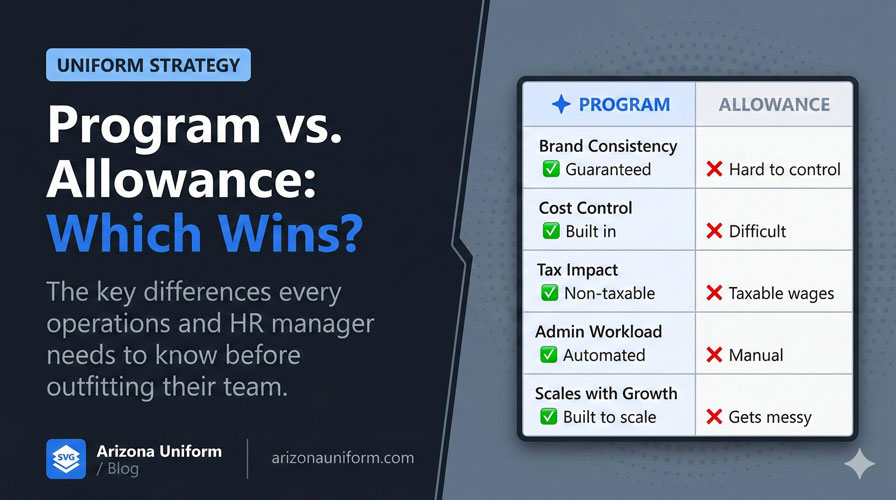
uniform program vs allowance

Uniform Program vs. Uniform Allowance: Which Is Better for Your Business?

If you’re responsible for outfitting your workforce, you’ve likely run into this question: Should you give employees a uniform allowance and let them figure it out, or build a managed uniform program that handles everything for them?

Both approaches have their place. But for growing businesses that manage teams across departments or locations, the difference between the two isn’t just operational; it’s financial, and it shows up in your brand every single day.

Here’s what you need to know before deciding.

What Is a Uniform Allowance?

A uniform allowance is a set dollar amount given to employees either as part of their paycheck or as reimbursement for purchasing their own work attire. It’s simple to set up and requires almost no management overhead on day one.

The problem? Simple to set up doesn’t mean simple to manage.

When employees choose their own uniforms, you lose control over what your team actually looks like in the field. One technician shows up in a navy polo, another in a faded black tee, both technically within the “guidelines” but nowhere close to consistent. For customer-facing industries like HVAC, pest control, or property management, that inconsistency chips away at the professional image you’ve worked hard to build.

There’s also the tax and compliance side. Uniform allowances are typically treated as taxable wages, which means additional payroll burden for your business and less real value for your employees.

What Is a Managed Uniform Program?

A managed uniform program centralizes everything. Your uniform supplier, like Arizona Uniform, works with you to select approved products, set up a branded ordering portal, and handle inventory, fulfillment, and distribution for your entire team.

Employees order from a pre-approved catalog of branded items. You set the budget controls. The right uniforms show up at the right place, in the right sizes, on time.

The result is a workforce that looks uniform because it actually is.

Which One Is Right for Your Business?

A uniform allowance can work for very small teams or businesses with flexible appearance standards. But if you’re managing more than 10 employees, operating across multiple locations, or working in an industry where how your team looks directly affects customer trust, a managed uniform program will save you money, time, and headaches in the long run.

The businesses that stick with allowances the longest tend to be the ones most frustrated when they finally make the switch. The question isn’t really if a program makes sense. It’s how much longer you want to manage without one.

work uniform

Safety Standards for Car Wash Employee Uniforms: Visibility, Slip-Resistance, and Protection

Car wash operations present unique safety challenges that many business owners underestimate. Between slippery surfaces, moving vehicles, chemical exposure, and busy traffic patterns, employees face daily hazards that proper uniform selection can significantly mitigate. Understanding and implementing the right safety standards for car wash uniforms protects your workforce while reducing liability and creating a more professional operation.

Why Safety-Focused Uniforms Matter in Car Wash Operations

The car wash environment combines multiple risk factors into one workspace. Employees navigate wet floors while operating equipment, directing vehicle traffic, and handling cleaning chemicals. According to workplace safety data, slips, trips, and falls account for a significant portion of car wash injuries, with vehicle-related incidents and chemical exposure adding to the risk profile.

Workplace safety and compliance extends beyond training and procedures. The clothing your team wears serves as the first line of defense against common hazards, making uniform selection a critical safety decision rather than merely an aesthetic choice.

High-Visibility Requirements for Traffic Safety

Car wash facilities, especially those with active drive-through lanes or outdoor drying areas, require employees to work in close proximity to moving vehicles. High-visibility clothing becomes essential in these environments, particularly during early morning, evening, or inclement weather conditions when driver visibility decreases.

ANSI/ISEA 107 standards define high-visibility safety apparel requirements based on work environment risk levels. For car wash operations with active vehicle traffic, Class 2 or Class 3 high-visibility garments provide appropriate protection. These uniforms feature fluorescent background materials in safety yellow, orange, or red, combined with retroreflective striping that reflects vehicle headlights.

While not all car wash positions require full high-visibility compliance, employees directing traffic, working in parking areas, or operating in dimly lit facilities benefit significantly from enhanced visibility features. Even incorporating reflective trim or bright color blocking on standard uniforms improves safety margins without requiring full ANSI compliance.

Slip-Resistant Footwear: The Foundation of Car Wash Safety

Wet floors represent the most persistent hazard in car wash operations. Water, soap residue, and cleaning chemicals create slippery conditions that standard footwear cannot safely handle. Slip-resistant footwear specifically designed for wet environments becomes non-negotiable for car wash teams.

Quality slip-resistant shoes feature specialized rubber outsoles with deep tread patterns that channel water away from the contact surface, maintaining traction even on wet floors. Look for footwear rated for oil and water resistance, with closed-toe designs that protect against chemical splashes and falling objects.

Many car wash operators make the mistake of treating footwear as a secondary consideration, but proper slip-resistant shoes reduce injury rates dramatically. When implementing uniform programs for your car wash business, footwear should receive equal attention to clothing selection, with clear standards communicated and enforced consistently.

Chemical-Resistant Fabrics and Protective Features

Modern car wash operations use various cleaning chemicals, from mild soaps to acidic wheel cleaners and waxes. While most car wash chemicals aren’t severely hazardous, repeated exposure can cause skin irritation, and accidental splashes can damage standard clothing or reach the skin underneath.

Uniforms constructed from synthetic blends or treated fabrics offer better chemical resistance than cotton alone. Polyester-cotton blends resist absorption, allowing chemicals to bead off rather than soaking through to skin. Some advanced fabrics include chemical-resistant treatments that provide additional protection without sacrificing comfort or breathability.

Beyond fabric selection, uniform design matters for chemical protection. Long sleeves provide more coverage than short sleeves, and higher necklines protect the chest area. However, balance protection with comfort since car wash work is physically demanding and often occurs in warm weather. Many operations find that providing both short and long-sleeve options allows employees to choose appropriate protection based on their specific tasks and weather conditions.

Water-Resistant and Quick-Drying Materials

Unlike chemical resistance, which prevents liquid penetration, water resistance for car wash uniforms focuses on managing moisture that inevitably contacts clothing. Employees working in automatic car wash bays, hand-washing vehicles, or operating spray equipment will get wet regardless of precautions.

Water-resistant uniforms designed for car wash environments use moisture-wicking fabrics that pull water away from skin while drying quickly. This technology keeps employees more comfortable throughout their shifts and reduces the risk of skin issues caused by prolonged moisture exposure.

Quick-drying properties also improve uniform appearance and hygiene. Uniforms that remain saturated look unprofessional and can develop odors, while quick-drying fabrics maintain a cleaner presentation even in wet conditions.

Durability Standards for High-Wear Environments

Car wash work is physically demanding, with employees constantly moving, bending, kneeling, and reaching. Uniforms must withstand this activity level plus exposure to water, chemicals, and frequent laundering without degrading quickly.

Reinforced stitching at stress points, double-layered knees for employees who kneel frequently, and industrial-grade fabrics extend uniform life significantly. While higher-quality uniforms cost more upfront, their durability reduces replacement frequency and maintains professional appearance longer, ultimately delivering better value.

Implementing Safety Standards in Your Car Wash Uniform Program

Creating a safety-focused uniform program starts with assessing the specific hazards your employees face. Walk through your operation and identify where high-visibility clothing is needed, where chemical exposure risks are highest, and which positions face the greatest slip hazards.

Document these requirements clearly and incorporate them into your uniform standards. When working with a uniform provider, communicate these safety priorities explicitly so appropriate products can be selected. Arizona Uniform specializes in developing uniform programs that balance safety requirements with comfort, durability, and brand presentation.

Consider role-based uniform specifications rather than a one-size-fits-all approach. Employees directing traffic need different safety features than those working in covered wash bays. Creating position-specific standards ensures everyone receives appropriate protection without over-engineering uniforms for lower-risk roles.

Safety-focused uniforms represent an investment in your most valuable asset—your employees—while reducing injury-related costs and liability exposure. By implementing proper safety standards in your car wash uniform program, you create a safer workplace and demonstrate genuine commitment to employee wellbeing.

a person using his calculator

The Cost of Fragmented Uniform Ordering in Growing Organizations

As organizations grow, systems that once felt manageable often struggle to keep pace with new demands. Uniform ordering is a common example. What begins as a simple process handled by different teams can quickly turn into a web of manual processes, disconnected vendors, and inconsistent results. For growing companies, fragmented uniform ordering increases hidden costs, limits business operational efficiency, and creates missed opportunities that directly affect long-term success.

At Arizona Uniform, we work with organizations navigating changing market dynamics that recognize that uniforms are no longer just apparel, but an operational system that requires structure, visibility, and the right digital solutions.

How Fragmented Ordering Takes Hold

Fragmentation usually develops over time. One department places orders through email. Another uses a local retail source. A third relies on spreadsheets or shared files. These manual processes introduce human error, slow response times, and create confusion around access, approvals, and accountability.

As more locations and staff members are added, inventory management becomes increasingly complex. Incorrect orders, wrong sizes, and inconsistent customization options become common, especially when new employee onboarding happens quickly. What once felt flexible becomes time-consuming and difficult to control.

The Real Impact on Operational Costs

The financial impact of fragmented uniform ordering often goes unnoticed at first. Hidden fees from rush shipping, inconsistent pricing, and frequent reorders quietly add up. Additional costs arise from ongoing maintenance, excess inventory, or emergency replacements due to supply chain disruptions.

Without detailed reporting, leadership teams lack insight into spending patterns and cannot accurately assess the actual cost of uniforms. Procurement decisions are made without the data needed to support a cost-effective solution, limiting the organization’s ability to control budgets and plan.

Operational Strain Across Different Teams

Fragmented systems place unnecessary strain on internal teams. Managers spend valuable time tracking down order status, correcting incorrect orders, and resolving uniform-related issues instead of focusing on core tasks. Procurement teams lack the tools and resources needed to manage uniform programs efficiently across locations.

As organizations grow, these inefficiencies slow development and reduce overall productivity. Uniform ordering becomes a distraction rather than a support function, pulling attention away from higher-value priorities.

Inconsistent Employee Appearance and Brand Risk

Uniforms play a critical role in employee appearance and brand identity. When uniforms are sourced from multiple suppliers without oversight, inconsistencies in style, color, and quality become visible to customers. This affects customer preferences, trust, and the brand’s overall perception.

For companies operating in regulated environments, fragmented ordering also introduces regulatory compliance risk. Without a single source of approved garments, there is no guarantee that uniforms meet safety or industry requirements across all locations.

Missed Opportunities During Onboarding

Few challenges highlight fragmentation more clearly than onboarding. When uniforms are late, unavailable, or incorrect, new employees start behind schedule. Delays caused by inventory shortages or poor coordination slow productivity and negatively impact early employee experiences.

A lack of integration between ordering systems, inventory tracking, and fulfillment leads to missed opportunities to create a smooth, professional onboarding process. These delays affect both operational momentum and employee confidence.

Why Digital Solutions Change the Game

Replacing fragmented ordering with one platform is a game-changer for growing organizations. A centralized, e-commerce-based uniform system allows active users to place approved orders through a single source, improving consistency. Automation replaces manual processes, reducing human error and accelerating fulfillment.

With digital solutions, organizations gain real-time visibility into managing inventory, optimal stock levels, and order status. Detailed reporting provides leadership with actionable insights to improve decision-making and align uniform programs with business goals.

Improving Supply Chain Visibility and Speed

A centralized platform increases visibility across the supply chain, supporting faster delivery and more predictable fulfillment. Instead of reacting to shortages or delays, organizations can proactively manage uniform needs using accurate data and integrated tools.

This level of control allows teams to respond quickly to growth, seasonal changes, or shifts in market demand while maintaining consistency across all locations.

Building Long-Term Value Through Centralization

Fragmented uniform ordering creates inefficiencies that compound as organizations grow. Centralization transforms uniforms from an operational burden into a strategic asset. By using one platform supported by a dedicated team, businesses reduce operational costs, eliminate unnecessary waste, and improve overall business efficiency.

At Arizona Uniform, we help leading organizations move away from outdated systems and toward integrated, scalable uniform programs. Our approach combines technology, expertise, and ongoing support to ensure uniforms bolster growth rather than hinder it.

If your organization is experiencing challenges with fragmented uniform ordering, it may be time to reassess the actual cost of the current approach.

Visit our website to learn how a centralized, digital uniform solution can reduce costs, improve efficiency, and support long-term success across your organization.

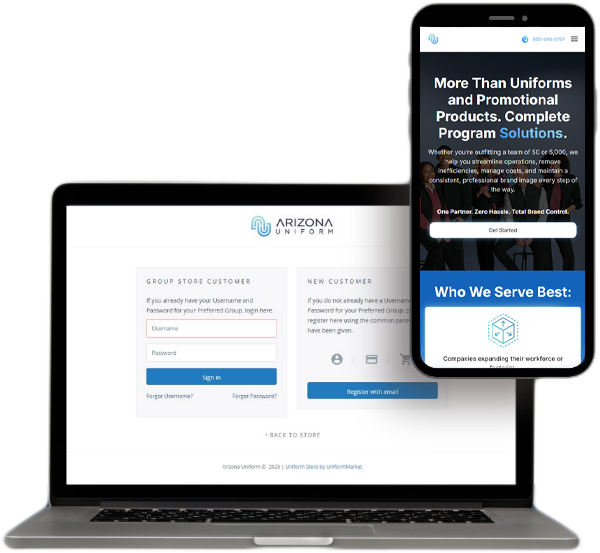
Branded online ordering portals png

The Hidden Operational Advantages of a Digital Uniform Ordering System

Managing company uniforms across multiple locations, departments, and job roles requires more than the traditional approach many businesses rely on today. What appears simple on the surface, such as ordering uniforms, keeping items stocked, and ensuring employees have what they need, is often just the tip of a much larger operational challenge. Manual uniform management introduces hidden costs, onboarding delays, inconsistent brand presentation, and major inefficiencies that grow as an organization expands.

A modern uniform management system solves these issues by bringing structure, visibility, and control to every part of the process. At Arizona Uniform, we help organizations transform their approach with a digital workwear management system designed for operational efficiency and long-term value.

Improving Efficiency Through Centralized Ordering

A digital online store is one of the most effective tools for improving uniform procurement. Instead of staff members placing their own orders through emails, spreadsheets, or scattered vendor platforms, everything funnels through one efficient system. This reduces errors, prevents duplicate purchases, and provides teams with clear oversight. A properly built system increases procurement efficiency and helps organizations streamline operations by ensuring employees can easily access approved items without confusion.

Traditional, manual uniform management often results in oversized budgets, unnecessary costs, and operational slowdowns. A digital platform eliminates these issues by guiding users toward the correct uniforms based on job role, location, or department, supporting consistent inventory control and keeping the ordering process aligned with brand expectations.

Real-Time Insights for Better Decision-Making

A key benefit of a digital uniform management system is access to real time inventory tracking and detailed reporting. Many businesses struggle with guessing inventory levels, losing track of what has been ordered, and discovering shortages only when it’s too late. Real-time visibility enhances inventory management, reduces the risk of overspending, and helps organizations maintain inventory control across every location.

Leaders can monitor order status, track spending limits, evaluate usage patterns, and understand the true cost of ordering uniforms. These insights give procurement teams the data they need to reduce costs, eliminate waste, and make informed decisions that support long-term savings. For industries like manufacturing, retail, healthcare, or field services, the ability to anticipate needs is critical for smooth operations.

Reducing Hidden Costs and Avoidable Disruptions

When evaluating uniform programs, many businesses overlook the hidden costs tied to outdated systems. Manual ordering often leads to incorrect sizes, off-brand selections, overstocked inventory, or missing items that require rush shipping. Add in laundry service issues and inconsistent replacement schedules, and the expenses climb quickly.

A digital workwear management system prevents these issues by automating order approval and enforcing spending limits set by leadership. This ensures every order aligns with budget expectations while reducing the administrative burden on supervisors who previously had to manage uniform-related tasks manually.

Consistent Company Uniforms Across All Locations

For multi-location businesses, maintaining consistent company uniforms is essential for brand identity and customer experience. A digital platform ensures every employee receives the same approved garments, whether they need everyday workwear, safety-specific items, or compliant items for regulated environments.

With a vast array of uniform options, customization features, and role-based filters, the system ensures employees always receive garments that match brand guidelines and job responsibilities. This consistency improves the customer experience, supports corporate identity, and ensures employees look professional across all touchpoints.

Solving Onboarding Delays and Workplace Interruptions

Few things slow down operations more than onboarding delays caused by missing uniforms. When new hires start without proper attire, managers often scramble to find last-minute solutions, pulling them away from other critical tasks. A digital system eliminates this bottleneck by maintaining optimal stock levels and simplifying the process of ordering uniforms for incoming employees.

With predictable workflows and fast turnaround, companies avoid interruptions to training and scheduling. Ensuring employees have what they need on day one improves first impressions and sets the tone for a professional, efficient workplace.

Incorporating a Future-Ready Strategy

Implementing a digital uniform management system is more than a technology upgrade, it’s a strategic investment in the future. Businesses that adopt efficient, automated processes gain an operational advantage, allowing them to scale without experiencing typical growing pains. The system supports a wide variety of industries, from manufacturing to facility services, and ensures alignment with modern business demands.

Case studies from many businesses show that digital uniform transformation reduces costs, improves customer trust, and strengthens internal processes. It equips organizations with tools that grow with them, supporting not only today’s requirements but also broader strategic goals.

Unlock Lasting Value With a Digital Uniform Program

A well-designed digital uniform management system transforms something as routine as workwear into a driver of efficiency, consistency, and long-term savings. By reducing hidden costs, enhancing inventory accuracy, and improving the experience for both clients and employees, organizations can streamline operations and strengthen their presence across every location.

At Arizona Uniform, we help companies implement digital uniform solutions that support modern operational needs while maintaining brand integrity and employee satisfaction. If you’re ready to replace outdated methods with a more efficient, reliable system, we’re here to help you build a program that delivers lasting value.

Visit arizonauniform.com to learn how a digital uniform management system can reduce costs, boost efficiency, and support your future growth.

workers in their work uniform

The Financial Impact of Poorly Managed Uniform Programs on Large Organizations

Uniforms play a crucial role in business operations, especially for large organizations with multiple locations and more employees to manage. Uniforms are more than clothing, they are tools for ensuring compliance with safety regulations, reinforcing brand consistency, and supporting employee morale. However, without a clear uniform strategy in place, organizations face rising uniform rental costs, frequent replacements, and unnecessary administrative burden. Poor uniform management not only creates operational inefficiencies but also drains resources that could otherwise go toward revenue generating activities.

The Hidden Costs of Poor Uniform Management

One of the most overlooked aspects of managing employee uniforms is the financial drain caused by worn out uniforms, hidden fees in uniform rental programs, and supply chain disruptions. Procurement teams often struggle with additional costs when buying uniforms that don’t align with quality standards or brand values.

These issues compound as the company grows, requiring careful planning to reduce costs and improve efficiency. Without streamlined processes and accurate uniform inventory tracking, businesses risk wasting resources.

Uniform Quality and the Role of Strategy

Uniform quality directly impacts safety standards, employee engagement, and brand image. High quality uniforms ensure compliance with industry regulations and provide materials required for specific work environments, such as flame resistance for energy workers, or water and sweat wicking features in wet environments.

A strong uniform strategy considers several factors: employee feedback, quality control, branding elements like company logos, and safety standards, ensuring that new uniforms are designed to meet both functional and branding needs. When these core components are neglected, uniforms quickly become a source of additional costs rather than a solution for efficiency.

Operational Efficiency Through Standardization

Uniforms play a crucial role in operational efficiency. Consistent branding across departments and locations builds trust with customers, reinforces brand values, and allows employees to feel confident in their professional appearance. By creating uniforms that reflect the company’s commitment to safety and professionalism, businesses can boost employee morale and foster team cohesion.

Streamlined processes, such as centralized online ordering and uniform rental programs with transparent pricing, help procurement teams make informed decisions and avoid the pitfalls of hidden fees or poor vendor selection.

Employee Morale and Engagement

Employee uniforms are more than just apparel; they serve as a daily reminder of belonging and unity. When uniforms are poorly managed, arriving late, not meeting safety standards, or showing signs of wear, employees may feel undervalued.

On the other hand, providing consistent, high quality uniforms that meet safety regulations and brand expectations can boost employee morale, encourage engagement, and enhance team spirit. Allowing employees to contribute through employee feedback ensures that uniform strategy aligns with both business needs and worker satisfaction.

Brand Consistency and Professional Image

Uniforms serve as one of the most visible branding elements in any organization. Consistent branding across multiple locations strengthens brand recognition and demonstrates the company’s commitment to quality. When poorly managed, however, it can lead to inconsistencies in company logos, color schemes, and uniform quality, weakening your brand identity.

For large organizations, brand consistency is a key benefit of a well-executed uniform program. With careful planning, organizations can avoid frequent replacements, control uniform costs, and ensure compliance with quality standards while preserving their professional image.

The Cost of Reactive vs. Proactive Management

Without proactive uniform management, issues are rarely addressed promptly. Worn out uniforms linger, hidden fees in uniform rental programs go unnoticed, and procurement teams spend unnecessary time fielding complaints.

This reactive model not only increases additional costs but also diverts focus away from more productive actions. By contrast, a proactive approach, rooted in careful vendor selection, quality control, and streamlined processes, provides long term savings and operational stability.

The Crucial Role of a Managed Program

A managed uniform program reduces the administrative burden, improves efficiency, and ensures safety standards are met across all departments. From uniform inventory tracking to procurement planning, every step is designed to prevent unnecessary costs and disruptions. By aligning uniform management with business needs, organizations can achieve cost savings, safeguard employees, and strengthen their brand values. The key benefits include:

  • Ensuring compliance with industry safety regulations and quality standards
  • Reducing uniform costs and frequent replacements through quality control
  • Boosting employee morale and engagement with consistent, high quality uniforms
  • Streamlining procurement processes to reduce administrative burden
  • Reinforcing brand consistency across all locations for customers and employees alike

Building Long-Term Value With Arizona Uniform

Poor uniform management creates unique challenges that drain resources, lower employee morale, and weaken brand consistency. But with careful planning and a partner who understands the crucial role uniforms play in safety, branding, and employee engagement, businesses can scale successfully while reducing costs.

At Arizona Uniform, we specialize in creating tailored solutions that balance quality standards with cost efficiency, allowing employees to feel confident and organizations to achieve operational success.

Contact us today to learn how a managed program can help your company reduce costs, ensure compliance, and create uniforms that reflect your company’s commitment to safety, professionalism, and long term savings. Visit our website to get started.

workwear uniform

How Uniform Programs Enhance Workplace Safety and Compliance

For businesses across various industries, especially those operating in regulated or hazardous environments, safety and compliance are daily essentials, not optional efforts. While policies, training, and equipment get much of the attention, one often underestimated factor in building a safer workplace is the implementation of a well-managed uniform program.

At Arizona Uniform, we help companies develop scalable uniform systems that go far beyond appearance. Our programs are designed to reinforce regulatory compliance, promote safety, and reduce operational risks across departments and locations.

Uniforms as a Critical Safety Tool

Uniforms are an essential form of personal protective equipment. Whether it’s flame resistant garments for electrical crews, reflective strips for night crews, or specialized uniforms for food processing environments, these items directly contribute to safeguarding employees from workplace hazards. When designed and worn properly, uniforms reduce exposure to chemicals, moving parts, and visibility risks, all while contributing to employee safety and comfort through benefits like temperature regulation.

A managed uniform program ensures teams receive the right gear on time, preventing gaps in coverage and helping businesses meet safety compliance requirements under agencies like OSHA (Occupational Safety and Health Administration). By controlling inventory, fit, and delivery, we give companies full control over how functional uniforms are deployed for worker safety.

Supporting Compliance Across Multiple Locations

Companies with multiple locations often struggle with consistent enforcement of industry standards and safety regulations. When departments source their own gear, oversight weakens and regulatory requirements are more likely to be missed. With Arizona Uniform’s structured approach, your program is centralized, so only approved, compliant uniforms that are up to safety standards make it into the hands of your team members.

Through our customized online store platform, employee’s uniforms are matched to their job function, streamlining the ordering process while helping you maintain a clear record for audits and regulatory compliance.

Durability, Fabric, and Visibility Matter

Uniforms designed with reflective materials, treated cotton, and breathable fabrics improve comfort, safety and professionalism. High-stress jobs, from construction sites to machinery operators, require gear that holds up to physical demands while enhancing visibility, regulating body temperature, and resisting fire or tears. Low-quality gear leads to dirty uniforms, torn garments, and poor protection, leading to greater risk of workplace injuries and employer liability.

Uniforms play an essential role in ensuring compliance with workplace safety. When materials are standardized and aligned with industry regulations, you create consistency in both function and look, supporting brand identity and safety protocols while ensuring clean uniforms are always in circulation through reliable uniform maintenance programs.

Role-Specific Uniforms That Make Safety Clear

Different jobs call for different protection. One-size-fits-all doesn’t work in a compliant operation. Our systems break down uniform assignment by role, ensuring the right safety uniforms, such as water resistant clothing or garments built for low light conditions, are deployed as needed.

This clarity helps identify employees by department, meets compliance requirements, and eliminates confusion during emergencies. It also fosters team unity and keeps internal processes aligned with evolving regulations that demand precise apparel based on role-specific risks.

Accountability and Inventory Visibility

A robust uniform program includes comprehensive inventory management, ensuring that employees wear only what’s approved, and nothing is overlooked. With full visibility into purchase history, refresh cycles, and usage, employers can identify supply gaps, schedule uniform replacements, and prevent lapses that could result in accident risk or citations.

Our digital system simplifies tracking and uniform maintenance, enabling smarter decision-making and faster fulfillment. When safety and availability are predictable, workplace operations improve, and compliance requirements are consistently met.

Safety Culture Through Appearance and Morale

Uniforms also play a role in perception. Uniforms improve how teams view their roles and how they’re perceived by customers alike. Well-designed, properly fitted uniforms elevate professional appearance, reinforce brand visibility, and boost employee morale.

Quality uniforms help employees feel seen, valued, and part of something bigger, enhancing employee satisfaction, loyalty, and retention. Uniforms that reflect your brand image while supporting a professional image signal a company committed to excellence and safety.

More Than Gear

Outfitting your team is more than just a dress code. Prioritizing the safety of your employees serves as a visual promise to your customers, staff, and regulators. When your people look consistent, clean, and confident, it reinforces brand recognition, inspires trust, and reflects a well-managed business. Especially in industries that require high-touch service or hazardous tasks, that kind of company identity can become a part of your competitive edge.

A Safer Workplace Starts With the Right Uniform Program

Arizona Uniform helps organizations across the region build safety-focused uniform programs that align with their operational, regulatory, and brand needs. Whether you’re managing uniforms for multiple job types, working in highly regulated industries, or expanding your team across locations, we provide the structure, accuracy, and oversight to keep your business compliant and your workforce protected.

Contact us today or visit our website to learn how we help you develop uniform systems that enhance safety, support compliance, and create lasting value.

work uniform

The Hidden Value of Uniform Standardization Across Departments and Locations

Uniforms are often viewed as a visual necessity, a way to identify staff, promote cleanliness, or meet industry dress codes. But for companies scaling across multiple departments and locations, standardizing uniforms unlocks a deeper level of value. At Arizona Uniform, we partner with growing businesses to create uniform programs that support brand unity, operational clarity, and workforce efficiency across all areas of an organization.

In this article, we examine the often-overlooked value of uniform standardization, offering precise insights into why uniform consistency is crucial for achieving long-term business success.

Consistency That Enhances Brand Identity

When employees across different departments wear inconsistent uniforms, it dilutes your brand identity. Whether it’s mismatched logos, fabric types like polyester vs. cotton, or various decoration methods, it creates confusion and reduces trust. Uniform standardization is a calculated decision that strengthens both brand recognition and professionalism internally and externally.

Customers, partners, and new employees instantly recognize who is part of your organization, regardless of the department or location. For example, businesses expanding into new markets need immediate brand cohesion. Uniform standardization delivers that visual unity from day one, allowing organizations to compete more confidently and present a strong, unified front.

Operational Efficiency Through Standardization

From an operational standpoint, the absence of uniform standardization often leads to inefficiency and waste. Procurement processes vary across locations. In many cases, departments are fielding their own uniform orders with different vendors and inconsistent pricing. The result is misused budgets, poor storage practices, and delays that impact productivity. With one standardized program, you control the length of the ordering process, gain visibility over use and spending intervals, and simplify fulfillment.

Centralized ordering through our online company store system reduces errors and improves storage accuracy. It also eliminates the need to draw from multiple sources, giving back time and resources to core operations. With better control, companies can prevent common disruptions in supply, increase availability of high-demand items, and maintain focus on core business functions.

Supporting Culture and Customer Expectations

Customer satisfaction and internal culture are also influenced by uniform consistency. When a customer walks into one of your locations, they expect to be able to identify team members easily. Inconsistent uniforms, or worse, a lack of them altogether, miss that expectation. Employees also notice.

Wearing standardized, quality garments reinforces their role, builds a stronger connection to the organization, and supports customer trust. It reflects ownership in the brand and signals that the company values its presentation and service. These small but visible efforts make a meaningful difference in how your business is perceived in competitive environments.

Technology and Tools That Make It Work

Technology plays a critical role in enabling standardization. Arizona Uniform offers clients a tailored online ordering system that includes only approved garments, controls customization, and ensures proper sizing and decoration. The introduction of this tool allows for quick order placement, simplified tracking, and real-time access to program information. It removes the burden of manual management while improving fielding of requests across multiple departments.

This system ensures that uniforms arrive on time, match branded content specifications, and are ready to meet the needs of both new and existing employees at any point. It also enables better availability forecasting and minimizes the chance of missing essential gear when it matters most.

Informed Planning for Long-Term Success

The benefits of standardization extend into long-term planning and business strategy. With accurate data about usage trends, order intervals, and inventory levels, decision-makers are better equipped to make informed changes that improve cost efficiency and align with business goals.

Ownership of a unified system allows leaders to set expectations, avoid overspending, and keep uniforms aligned with company values as the organization evolves. These strategies are not one-time fixes, they are part of a continuous effort to improve how companies manage appearance, logistics, and performance at scale.

Unlocking the Full Potential of Uniform Programs

Uniform standardization across departments and locations is a decision that helps maximize performance without increasing complexity. From reducing the length of onboarding for new hires to ensuring consistency in customer experience, it introduces structure where many companies face disorder. It provides a clear point of control that enhances your ability to respond to demand, maintain quality, and protect brand image.

At Arizona Uniform, we work closely with businesses to develop smart, cost-effective uniform strategies that work across all locations and teams. If your company is ready to upgrade from scattered solutions to a centralized, scalable program, we’re ready to help. Visit our website to get started.